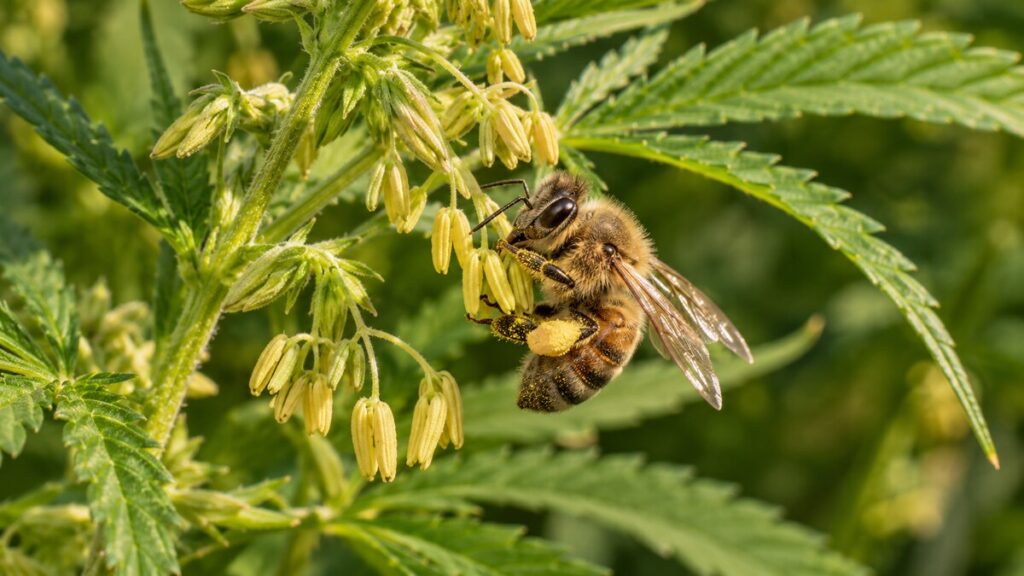
A bee drops onto a flowering hemp plant and comes away dusted with pollen. It looks like the opening scene of a familiar partnership. A flower supplies nectar, a bee gets a meal, and some pollen travels to another flower. Hemp scrambles that story. Its flowers offer no nectar, and the plant can get its pollen airborne without the help of a single insect. The visitor has come for the pollen itself.
A food source with no nectar counter
Pollen carries the plant’s male reproductive cells. To a bee it is also a source of protein and other nutrients, particularly important in feeding developing young. Nectar serves a different purpose as a major source of sugar. A patch of hemp shedding pollen can therefore provide one item on a bee’s shopping list even if it cannot provide the other. The value of that patch will depend partly on what else is flowering within reach.
Flowering time makes hemp especially interesting in agricultural landscapes. Fields that were full of bloom a few weeks earlier may now be setting seed. A plant releasing abundant pollen in that interval could attract insects that had plenty of alternatives earlier in the season. Cornell’s account of hemp as a pollen source in New York places the crop in that seasonal setting. There is no need to assume that bees favor hemp above other plants throughout the year.
Counting the visitors in a New York field
Nathaniel Flicker, Katja Poveda and Heather Grab made repeated sweep-net collections of bees visiting hemp on New York farms. In their study of the bee community, they identified sixteen species. Taller hemp varieties tended to host more bees and a wider range of species. The result was an association observed across plots. Height might affect how easily bees locate flowers, or taller plants might offer different amounts of pollen. A survey alone cannot separate those possibilities.
The surrounding land produced a subtler result. Simpler landscapes were associated with fewer visiting bees. The number of species recorded did not show the same relationship. Those statements are compatible. A patch visited by two individuals from each of six species has the same observed species richness as one visited by twenty individuals from each. A count of species leaves out how busy the flowers were.
A net catches only part of a season
A field survey records encounters during particular visits, in particular weather, using a chosen collection method. Another survey of industrial hemp in Colorado likewise documented bees on flowering hemp. Its species or genus counts cannot simply be added to the New York result. Different landscapes start with different bee communities, and measuring richness depends on how long and how thoroughly somebody looks.
Researchers who studied pollen from four hemp varieties alongside bee observations combined chemical measurements with visitor counts. That pairing opens a further question. If bees appear more often on one variety, are they responding to pollen composition, the amount available, the timing of release or the ease of finding the flowers? Measuring nutrients in pollen provides evidence for one possible explanation. It does not establish what an individual bee tasted or chose.
What the field gives back
The most ambitious claim about a flowering hemp field is that it might help sustain bees that later pollinate other plants. To test that claim directly, researchers would need to follow the benefits beyond the moment a bee lands. Does the pollen reach a nest? Does access improve reproduction or survival compared with a similar landscape lacking the resource? Counts of adult visitors answer an earlier question in that chain.
Watch the original bee again and the apparent contradiction falls away. A plant can release pollen to the wind while an insect collects some of the same pollen for its nest. What looks like a single exchange between flower and visitor is the intersection of two journeys. The wind helps explain how the plant reproduces. The bee helps explain where some of its pollen ends up.