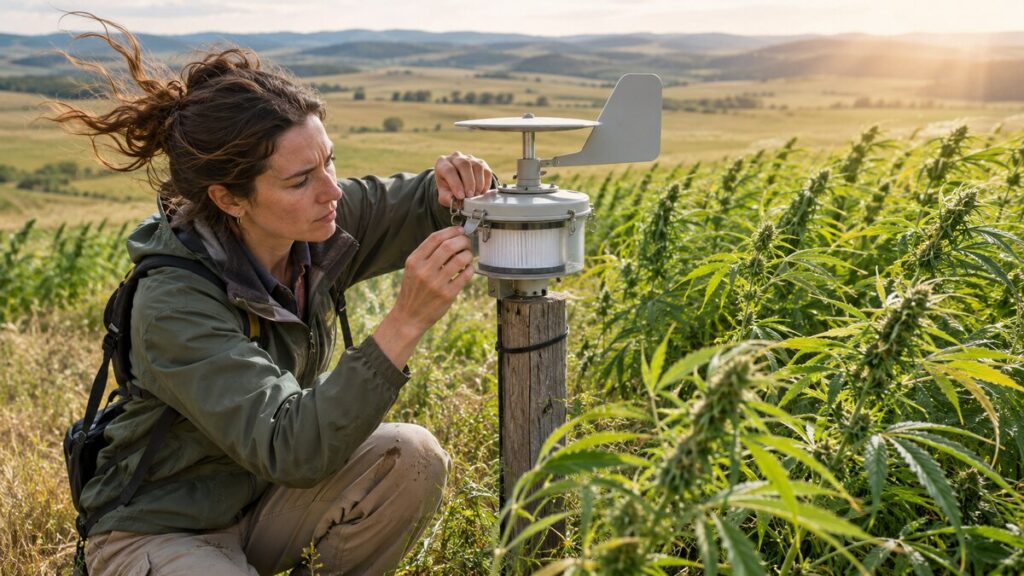
At the farthest sampling station in a hemp pollen experiment, 400 meters from the source, researchers were still finding grains. That fact is sometimes read as an answer to the question of how far hemp pollen travels. It is almost the opposite. Four hundred meters marked the place where the measuring stopped. The wind carried on.
What a pollen trap measures
A pollen grain leaving a hemp flower is small enough to be carried by air currents, yet heavy enough eventually to settle. A collector placed downwind samples some of the material passing through or landing at its location. Arrange collectors in several directions and the resulting map can show a strong downwind pattern. Leave them out over a period of changing weather and the accumulated pattern will look different from the footprint of a single afternoon’s breeze.
In an early field study by Ernest Small and Tanya Antle, collectors were positioned at increasing distances from a known source. Detectable deposition at the outer stations established that pollen reached them. It could not reveal where the last grain landed. Extending the array would improve coverage but would also make it harder to separate pollen from the chosen field from any other sources in the wider landscape.
A grain on a slide is one outcome
Arrival, viability and fertilization are separate events. A grain can settle on a collector after it has lost the capacity to fertilize a flower. A viable grain can land while the receiving plant has no receptive flowers. Counting seeds on recipient plants answers a different biological question from counting grains on a slide. And attributing a particular seed to a particular source calls for evidence about parentage.
Cornell’s work on industrial hemp pollen movement illustrates why researchers are interested in movement around source plants. The comparison of pollen capture methods hosted by the University of California raises an equally practical issue. A map is built from what the chosen collectors can recover. An empty collector after a brief sampling period sets a different limit on the evidence than an empty collector operating throughout flowering.
Put the wind inside the calculation
A regional study of cannabis pollen dispersal modeled particle movement under meteorological conditions across the contiguous United States. Instead of following labeled grains from every field, the investigators asked where modeled particles would go under specified weather conditions. Simulations allowed them to compare regions, seasons and times of day beyond the reach of any realistic network of field collectors.
Their results showed a contrast between day and night. Nighttime conditions tended to concentrate deposition nearer the source. Daytime conditions favored wider dispersal, with lower deposition rates as pollen spread out. Imagine the same handful of confetti scattered across a single table or the floor of an entire hall. Reaching more distant places and depositing fewer pieces at a particular place can be consequences of the same process.
Working backward from an airborne grain
Another approach begins with a grain already found at a monitoring station. Researchers examining airborne cannabis pollen in southeastern Spain used air-mass histories to investigate possible origins. A backward trajectory identifies places from which air could plausibly have arrived. It cannot give a grain a postal address. Local flowering records and the timing of detections help investigators decide which origins deserve consideration.
There are several honest answers to “how far?” One is the distance to the farthest collector with a documented grain in a particular experiment. Another is the distance over which a model predicts appreciable deposition under defined conditions. A third concerns the likelihood of successful fertilization at a particular field. Reporting which of these was measured makes an otherwise slippery number useful. In the original experiment, 400 meters was a well-supported observation precisely because nobody needed it to be the end of the journey.